Key takeaways
- Australian road safety leaders are calling for a national cultural shift as the country records its highest road toll in a decade.
- Panellists at Australian Road Safety Foundation’s Fatality Free Friday event agreed that lasting change will require greater personal responsibility, awareness of everyday risky behaviours, and stronger road safety education from an early age.
- Experts warned Australians may be becoming desensitised to road trauma, with complacency and distraction continuing to contribute to fatalities.
Australia’s road toll is climbing — and according to road safety experts, legislation and enforcement alone will not stop it.
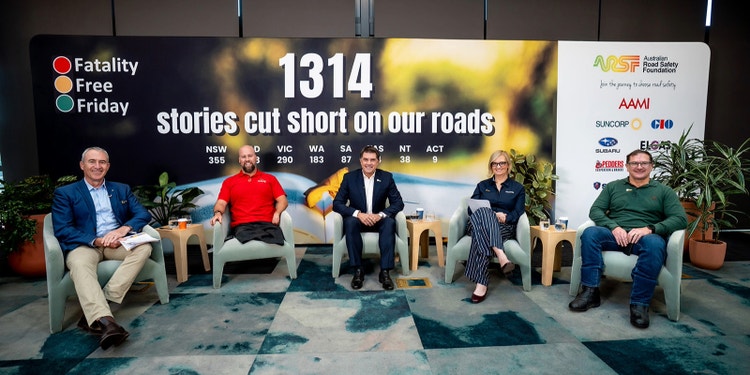
That was the confronting message delivered at this year’s Fatality Free Friday event, hosted by the Australian Road Safety Foundation (ARSF) at Suncorp’s Heritage Lanes in May.
Bringing together road safety advocates, policymakers and industry leaders, the event featured a panel discussion, which explored the urgent need for a national shift in attitudes and behaviours behind the wheel, warning Australia risks becoming desensitised to the devastating human impact of road trauma.

The event — livestreamed to Facebook and facilitated by journalist Mark Beretta OAM — featured ARSF Founder and Chair Russell White, Scania Director of Marketing and Communications Zsuzsa Zalatnai, Federal Member for Wide Bay Llew O’Brien MP, and AAMI Ambassador and motor safety advocate Ryley Batt OAM.
The most sobering statistic shared during the discussion was Australia’s road toll itself: 1,314 lives were lost in 2025 – the highest road death toll reported in a decade.
For nearly 20 years, Suncorp, AAMI and the Australian Road Safety Foundation have partnered to champion safer roads through sustained campaigning and advocacy, amid a continued rise in national road fatalities - including a 16 per cent increase since 2021.


For Mr White, the issue extends beyond road rules and enforcement.
“I think what we’ve seen is a disconnect between personal responsibility and also awareness for other people,” he said.
While legislation, policing and safer infrastructure all play an important role, Mr White argued meaningful progress ultimately depends on changing driver attitudes and rebuilding a stronger sense of community responsibility.
“I think we’ve lost some of this community connection since 2020,” he said.
“One of the challenges we have in road safety is that some of the things we need to fix can’t be fixed with a road rule, or more police, or better roads or better vehicles. It comes back to that human element and it’s that attitude that needs to change.

The speakers raised concerns about the vulnerability of young people on the roads, particularly the sense of invincibility often associated with inexperienced drivers.
“We have to move the needle from thinking about road safety as just following the road rules,” Mr White said.
“My view is that that needs to start back at school, potentially even pre-school, and drip-feed road safety along the way — not just compress it into the Learner/P-Plate phase.”
Mr O’Brien reflected on the impact road trauma has had within his own electorate, referencing a recent crash involving an unlicensed 14-year-old driver.
“If you’ve got a young kid in your house, you really should be treating your car keys like they’re bullets for a gun — put them somewhere they can’t be reached,” he said.
“The community is reeling from these disasters; but there still has to be a change of attitude in order to change it.”
While the discussion acknowledged the importance of leadership, legislation and education, panellists agreed lasting change would require Australians to move away from autopilot and improve their awareness when getting behind the wheel.
“Everyone needs to understand that whilst (driving) is so familiar to us, we’re engaging in what is potentially an extremely dangerous activity,” Mr O’Brien said.
“A lot of people believe that they’re doing the right thing; but it’s the little things like fatigue or distraction. People have got to be aware of it and change their attitudes.”
